Showing posts with label reise. Show all posts

Wednesday, September 25, 2019

Silvertone Chicago Vol.1


The corn cob towers.

This is the first time I've posted to the Chicago Neighborhoods Project in years. I stopped because I found trying to keep up with several types of social media was too time consuming. I am most active on Twitter at @ChiNeighbor. I have been tweeting videos of the city. I also feature snippets of Chicago Tribune newspaper articles from 1893 about the city and the World's Fair.

My longer term project is tentatively called "Tarot in the White City: Instructions, History and Advice from Chicago." I envision this as a book as centered around the amazing research about tarot that emerged in the early 1890s. Part of this knowledge has gone back into obscurity. For fun, I've designed a way to read tarot with a set of dominoes, a partial deck of playing cards, and a partial deck of modern tarot cards.

Visual Journal of the Fantastical City

As for photography, I've taken a new interest in shooting black and white (actually, silvertone) photos. I am exploring what is real and what is not. How the image of the city is constructed through our thoughts. Always there is an element of dreams to what we see.

The beer garden along the Riverwalk.
The autumn season. Shadowy figures crossing Wabash.
Corner clock on the Palmer House Hotel.

The Vietnam Veterans Memorial along the Riverwalk. Wedding couple on far left stairs.
The canopy of lights at the Palmer House Hotel.
Doorways of the Chicago City Hall/Cook County building.

The Riverwalk.

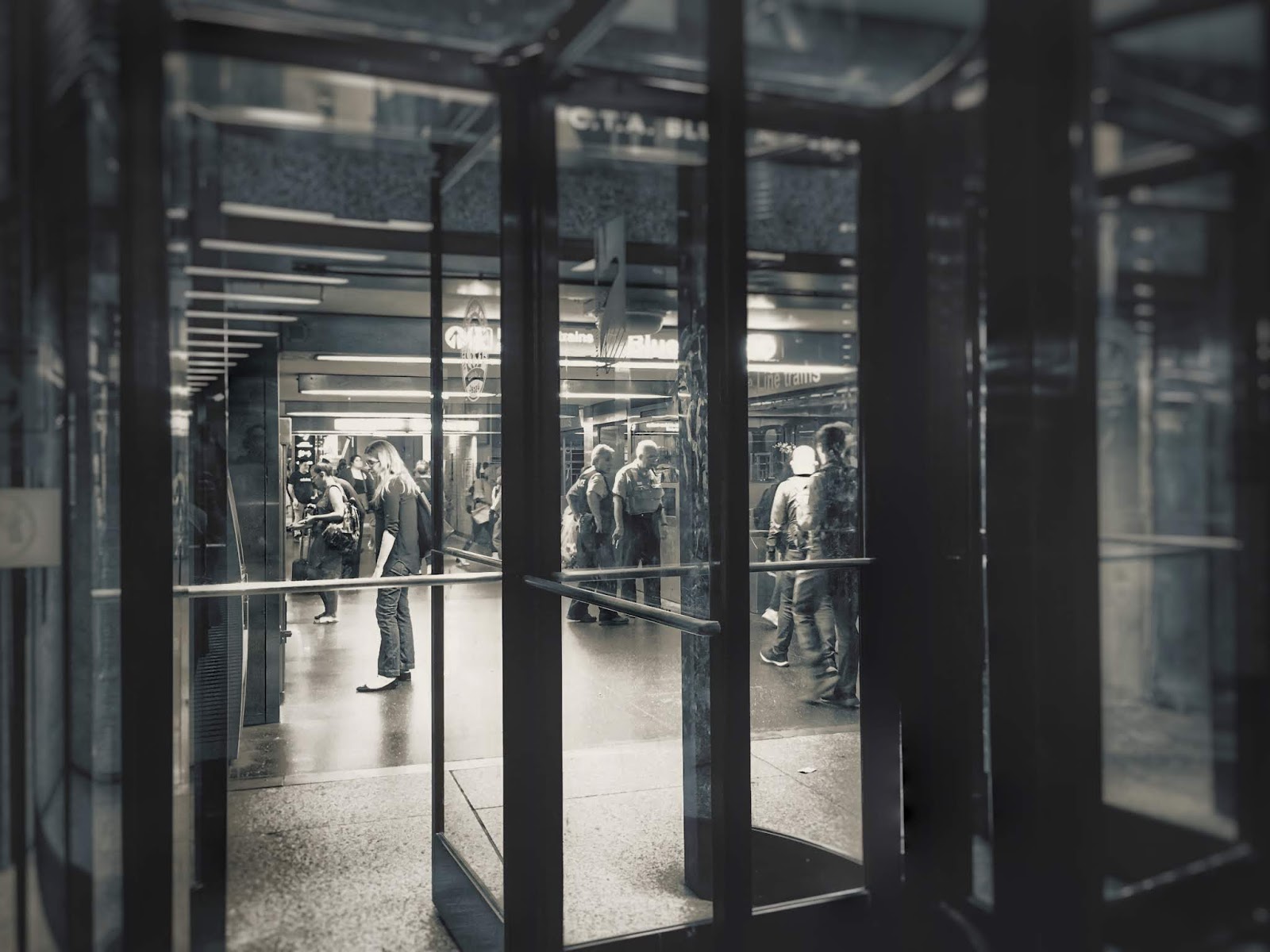
The entrance to the Blue Line along the underground tunnels of the Pedway.

Vending machines and snacks in the Pedway.


Sunday, May 22, 2016

Budget Guide to Chicago

Summer 2016


When the weather warms tourists flock to Chicago. Since I get requests for advice about what to see and do in the city, I’ve compiled a budget guide for visiting. Please feel free to leave your own tips.


Choosing What to Visit


Finding the expensive attractions is easy. They are well known. They appear on every website and guide book. Whenever I travel I’m on a limited budget and appreciate finding the cheap stuff. I prefer to blow my money on one big great thing, then supplement the rest of the trip with low cost or free activities.

The first time I go to a new city I spend most of the time simply walking around. If I’ve already been somewhere I prefer a return visit to explore a theme. In a metropolitan area as large as Chicago there is no way to cover all the museums from Millennium Park north to Lincoln Park, let alone the rest of the city. The sheer number of choices is overwhelming.

When friends come to visit I’m left trying to find out clues about what might interest them. If they like architecture, do they want to explore a larger area by walking on our own, or do they want a shorter, but much more informative, professionally guided tour? Do they prefer trolley, subway, bike or walking? (I draw the line at Segways.)

What aspect of architecture is compelling? Do they want skylines and a history if how Chicago developed? Or do they have a specific interest in churches, gothic architecture, hotel lobbies, Frank Lloyd Wright, park district field houses and conservatories, high end retail buildings, famous restaurants, train depots, public markets, or something else?

 Pick a Theme


I like to explore a city around a theme. Right now I’m interested in the Edwardian Era of history. In Chicago I would take some architectural tours of buildings and foods (Chicagoans often combine architecture and eating or drinking), check for museum exhibits, and visit some house museums like Glessner.

If you’re looking for something educational you might explore birds, Civil War history, cooking and foods, bridges, or whatever floats your boat. Chicago has a number of museums and cultural centers devoted to specific ethnic heritages, including Swedish, German, Lithuanian, African-American, Ukrainian, Mexican and Puerto Rico.

Chicago has an endless number of tours, concerts and lectures. The universities often have free or low cost theater, music and lectures. Likewise, neighborhoods sponsor inexpensive events.

In my own neighborhood of Hyde Park this summer we’ll have a series of free weekly evening concerts on our main street (53rd), free park concerts and movies, a free 3-day Jazz Festival, gallery openings, inexpensive museums on the University of Chicago campus, 4th of July parade and picnics with fireworks all night, fire pits for cookouts at Promontory Point, lectures, author readings, a new comedy club, and stuff I’m probably forgetting.


I haven’t listed the neighborhood restaurants, architecture, main business district, book stores, public sculptures, the cluster of seminaries, the lakefront, beaches, or the parks. We’re just one small area of the city, yet we have more cultural institutions than some entire small cities.

 
Pick an Area of Town


I recommend sticking to a particular area of the city rather than trying to cover a large territory. Why waste vacation time stuck sitting in traffic or waiting for the subway? Some of the neighborhoods have easy access on public transit to The Loop, Navy Pier, or the Magnificent Mile, but plenty of neighborhoods don’t. If everything you want to do is near the Navy Pier, paying higher hotel costs is worth the easy access.


Leave the Car at Home


I don’t recommend driving around Chicago. It may seem cheaper, until you have to pay parking. Some hotels offer lower room rates with expensive parking garages. Be sure to find out both. Driving to places like downtown is a nightmare and you’ll have to pay for parking. Other neighborhoods require a long search for a free spot.

You may find an inexpensive AirBnB rental with free parking. Fine, but how are you going to get to tourist attractions? Will you have an hour bus ride each way, including having to transfer? Are you going to drive and pay high parking fees when you arrive at your destination?

 
You Don’t Have to Visit the Art Museum


I hereby give you permission to skip anything which doesn’t interest you. You might be happier spending $300 on one of the best dinners of your life rather than slogging through days of boring museums.


Budget Ideas


Since money doesn’t grow on trees, here are some ways to see and do popular attractions without breaking the bank.

·         Discount Tickets: There are passes, Groupon, and last minute discounts.
·         Skyline: Instead of the Willis or Hancock towers, grab a drink at a rooftop bar.
·         River: Take the water taxi from Michigan Ave to Chinatown.
·         Meet Up: Check for free public tours.
·         Museums: Visit less well known museums.
·         Discount Shopping: Chinatown, Clark St in Andersonville, 26th St in Little Village


Links to Low Cost/Free Stuff


Chicago on the Cheap http://chicagoonthecheap.com/


Wednesday, May 4, 2016

Uptown


In mid-April my husband and I decided to visit Uptown. We’d read about some vintage shopping in the area. The beautiful weather had warmed to the 60s, after a chilly spring and some late season snowfalls.

We randomly chose the Argyle stop to exit the red line L train. I didn’t realize it was “Asia on Argyle” with a cluster of Asian restaurants and groceries. It’s as large as some entire Chinatown neighborhoods in other cities.

The population was diverse. Everywhere we traveled in the neighborhood we saw families, and groups of people, out enjoying the spring sunshine. Every block had people walking.

Broadway is the main commercial strip. I picked a Chinese dim sum restaurant for lunch. It was similar to a classic cafeteria, except the food was rolled on carts from table to table, instead of a buffet line. The waiter realized it was our first visit. He offered explanations about what was on the plates.

The waiter suggested a delicious sticky rice, with a meat center, steamed in Lotus leaves. We sampled several dishes. I particularly liked the pork dumplings. However, I don’t think I’ve had a dumpling I’ve ever truly disliked.

After lunch we walked over to the lake. I noticed some older buildings remain in the neighborhood, while others have been replaced with high rises, particularly from the 1960s and 70s, closer to the water. It seemed like an area of urban renewal projects, although the Encyclopedia of Chicago notes that the residents worked hard to avoid widespread displacement like Hyde Park.

We walked under a freeway bridge. One side of the underpass was lined with a tent city of homeless who lived permanently under the bridge. I’d read the city is supposed to be working on finding homes for people living in tent encampments around the city. The need for low income housing far exceeds supply in Chicago. This is particularly true because so many of the SRO hotels in the city have been demolished or converted to other uses.

Encyclopedia of Chicago describes Uptown as a former entertainment district for the city. The SRO hotels, which used to be clustered in the neighborhood, would have served singles and young couples, wanting an urban lifestyle instead of maintaining a house, similar to the micro-apartment concept today. (SRO hotels were more carefree, as they didn’t have kitchens and might include housekeeping.) Later the SRO hotels were used by migrant workers and as cheap housing to prevent homelessness.

Walking the neighborhood, we noticed a concentration of social services I don’t tend to see in other areas. We noticed housing for substance abuse services, the ill, and elderly. Walking past a doorway of an apartment building I saw plants which had been ripped out of their decorative pots. Dirt was scattered across the steps. Even in some of the roughest areas of the city I haven’t observed destruction of landscaping.

When we reached the lake the parks, trails and ball fields were full. A couple games of girls’ soccer were in progress. I watched a father teach a young boy how to fly a kite while pushing a baby along in a stroller, a group of preteen boys fishing, a couple strolling hand-in-hand along the rocks, small groups sitting on blankets, and a line waiting for food from the taco truck. Summer was in full swing.

Walking back through the neighborhood to the train we stopped at an Asian grocery. Like so many ethnic markets around the city they had great prices. I stocked up on 3 varieties of noodles, tea, and frozen pre-made pot stickers.

Until now I’ve resisted the notion of Chicago fusion cooking. I will look at a menu and think, “Those foods should not live together on the same plate.” I decided to take the plunge. I cooked Canton style eggs noodles from the market. I then added spaghetti sauce with onions, peppers, kielbasa and ham. It was strangely good. The noodles were light and brought out the flavors of the sauce. We ate the leftovers immediately.

I wouldn’t make the long cross town trip to eat at some of Chicago’s more authentic restaurants in the neighborhoods regularly. I’m glad I’ve done it once, but really, I tend to prefer “Americanized” versions of the foods closer to home anyway. I like the thin crust pizza I’ve had in South Loop better than what I tried at a liquor store in Albany Park, for example.  

At the same time, the small groceries are a different matter. Some neighborhoods have unique and inexpensive foods I can’t seem to find anywhere closer to our apartment. While the French and Maxwell Street Markets are a good start, too bad Chicago doesn’t have a giant public market once a week for shopping from small vendors across the city.


Thursday, April 21, 2016

West Ridge


In early April my husband, daughter and I decided to try a new food. My husband had been suggesting Middle Eastern for a while, although we never seemed to get around to eating it, despite a couple of decent restaurants near our home. After an online search we agreed to try something foreign to us—Shawarma cooking. We found some good restaurant reviews in West Ridge.

From downtown we took the brown line L train to the Western stop, then hopped a bus north. We arrived at an Assyrian Shawarma hole-in-the-wall restaurant, not quite in the neighborhood. We agreed to check it out, and if it didn’t appeal, we would find another among several options in West Ridge. The place was modest but the food looked good. The meat was slowly roasted on a spit, similar to Greek gyros. Our meals turned out to be delicious and plentiful.

I wouldn’t travel across town for a Shawarma meal again. However, if it was available in my own neighborhood, I would eat it on a regular basis. The unique foods are what makes so many of the individual neighborhoods of the city special.

After lunch we walked along Highway 41 before turning north into the residential areas. I was surprised to see some old motor court motels, like those typically found along old Route 66 across the country. In Chicago there’s not much left of the Mother Road. I was happy to find “Route 66” style architecture elsewhere in the city.

The Encyclopedia of Chicago notes West Ridge experienced a building boom from World War I through the 1960s. We found a diversity of architectural styles, from typical Chicago brick bungalows, a few with whimsical details, to unusual mid-century modern two-flats.

We walked until we reached Devon, the main business district street. The stores were quite diverse. Area residents included Indians, Pakistanis, Koreans, Middle Easterners, Bangladeshi, Russians, Assyrians, decedents of Germans and Irish, and the Midwest’s largest community of Hasidic Jews.
Unlike Albany Park, the different ethnic groups seemed comfortable comingling with each other. It was common to see bakeries with a mix of offerings or store signs in a variety of languages. My only complaint were the bagels we bought, which turned out to be more like bread rolls with a hole in the center, rather than the boiled dough goodness I’ve come to expect. We used them as sandwich buns.

The commercial district was thriving with a wide range of restaurants and types of local businesses. I got the sense the area is stable and not experiencing the pressures of either displacement, or abandonment, so common in the rest of the city.

We bought bakery breads, then explored a Middle Eastern market. I always like to look through the grocery shelves, trying to guess the items labeled in other languages. Like so many small ethnic markets around the city we found plenty of inexpensive items. We loaded up on boxes of tea and dry lentils.

In addition, I treated myself to a set of double metal tea kettles. I’d noticed them in some other Middle Eastern stores around town. Water is boiled in the larger bottom kettle, while the smaller top kettle heats. Then the smaller kettle is used as a pre-heated tea pot. They had several models, so I asked which they would recommend. The proprietor explained she preferred the set where the two kettles, large and small, could be used separately, and the top one included a fitted tea strainer. So far, I’ve used them daily with great results.