Showing posts with label photos. Show all posts

Wednesday, September 25, 2019

Silvertone Chicago Vol.1


The corn cob towers.

This is the first time I've posted to the Chicago Neighborhoods Project in years. I stopped because I found trying to keep up with several types of social media was too time consuming. I am most active on Twitter at @ChiNeighbor. I have been tweeting videos of the city. I also feature snippets of Chicago Tribune newspaper articles from 1893 about the city and the World's Fair.

My longer term project is tentatively called "Tarot in the White City: Instructions, History and Advice from Chicago." I envision this as a book as centered around the amazing research about tarot that emerged in the early 1890s. Part of this knowledge has gone back into obscurity. For fun, I've designed a way to read tarot with a set of dominoes, a partial deck of playing cards, and a partial deck of modern tarot cards.

Visual Journal of the Fantastical City

As for photography, I've taken a new interest in shooting black and white (actually, silvertone) photos. I am exploring what is real and what is not. How the image of the city is constructed through our thoughts. Always there is an element of dreams to what we see.

The beer garden along the Riverwalk.
The autumn season. Shadowy figures crossing Wabash.
Corner clock on the Palmer House Hotel.

The Vietnam Veterans Memorial along the Riverwalk. Wedding couple on far left stairs.
The canopy of lights at the Palmer House Hotel.
Doorways of the Chicago City Hall/Cook County building.

The Riverwalk.

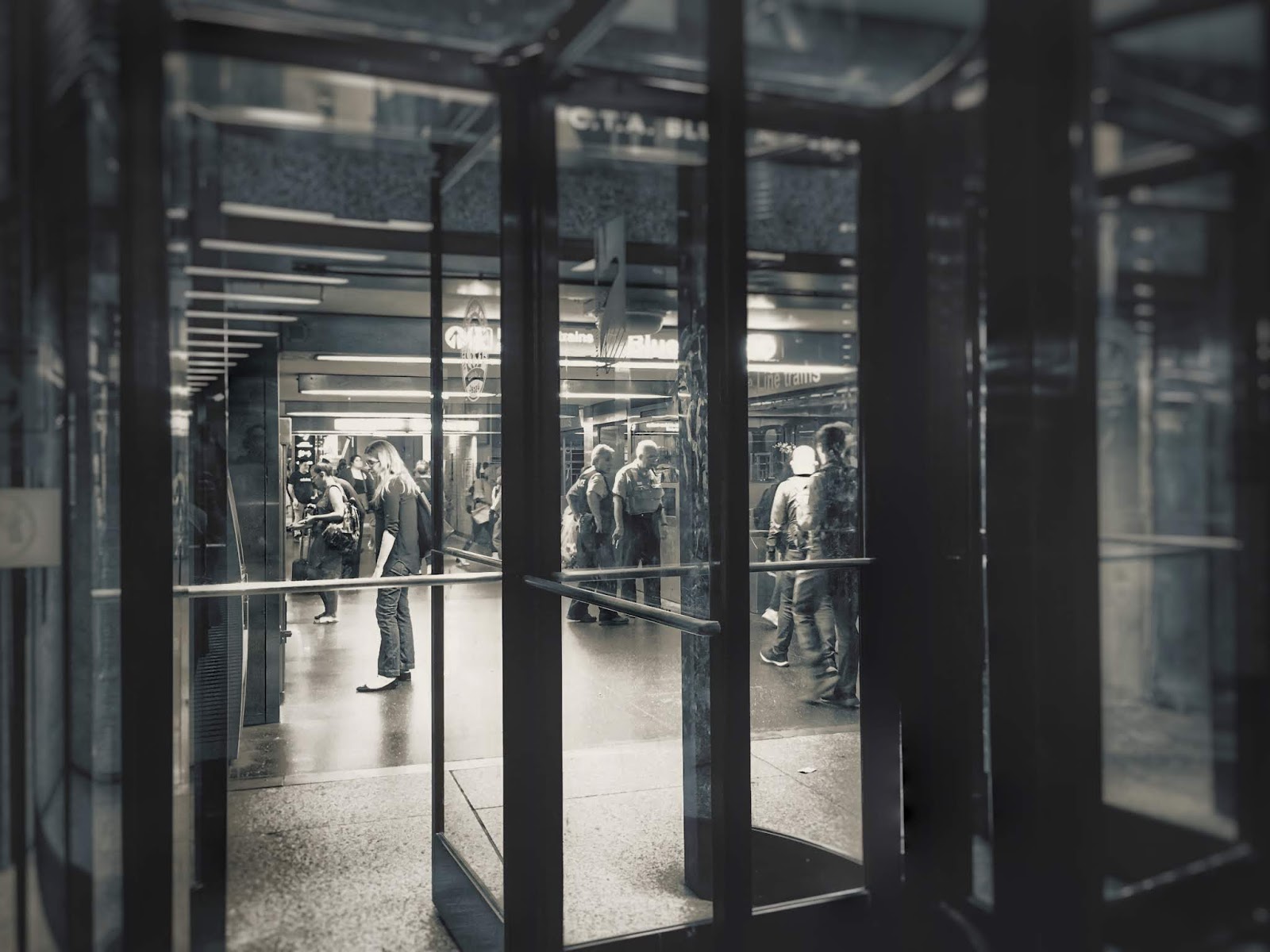
The entrance to the Blue Line along the underground tunnels of the Pedway.

Vending machines and snacks in the Pedway.


Thursday, February 9, 2017

Chicago: City of Bridges

When my daughter was around 4 years old we lived in Albuquerque, New Mexico. She was fascinated by bridges. She had a children's video about them, which she watched over and over, like kids will do. That summer we took a car trip with my mother, from our home, to Cleveland. When we arrived up north my daughter was amazed at the variety of bridges.

The highlight of the trip was our return home. My daughter and I left Cleveland on the Amtrak train back to the Southwest. We had a 5 hour layover transfer in Chicago. I don't know of any other city in America that can match Chicago for bridges. We were in awe.

Chicago has all the typical city bridges--freeway overpasses, rail lines, pedestrian walkways at airports, and connectors over rivers. In addition, the city was built in a swamp. Therefore, buildings are constructed in layers above the ground. Wacker Drive in downtown has three distinct levels, plus additional pedestrian links. To walk around the heart of the city is to constantly climb stairs and cross bridges.

The city has some unusual bridges. Part of the Pedway system is skyway bridges. It's is not limited to underground tunnels. There are industrial relics across the rivers. The Chicago Park District has an abundance of historic pedestrian bridges. If you look around you will find them everywhere.

When my daughter and I got off the train that summer trip I was surprised how accessible downtown Chicago was to the surrounding neighborhoods. It's easy to find somewhere to walk across the river. In some cities, like Los Angeles, few people walk. In other cities, natural barriers are too great. In New York there are few crossovers that span the long distance between Brooklyn and Manhattan. 

Still other places were designed without consideration for pedestrians. Getting in a vehicle, or riding the elevated free mass transit automated people mover, is the only way to get around downtown Miami. Chicago is unique.

Chicago is a city of bridges.
Vintage Postcard of Chicago Skyline
Downtown Chicago
Chicago River
South Branch of Chicago River
Uptown
South Loop
Pilsen
Lincoln Square
Lakeshore East
Hyde Park
Englewood
East Garfield Park
Chinatown in Armour Square
Bridgeport

Saturday, January 7, 2017

Chicago's Original Chinatown

My blog was inactive while I worked a job over the summer and fall. This winter I'm pleased to be back to my research, writing and photography on the Chicago Neighborhoods Project.


As I walk around the city I'm always curious if what I'm reading as an official guide is the same as what I'm seeing in the architecture. While it's easy to edit out words from texts, the buildings still retain details of history, which have since been omitted from written accounts.

When I spot these irregularities I can research to find out the rest of the story.

Chicago's designated Chinatown, on the South Side, looks like a tourist destination to me. It was built with exaggerated architecture, drawing attention to itself, at a time when the Chinese in the USA were a target for extreme prejudice and even physical attacks. Asians are the only nationalities we've completely banned from entering the country. This creates a big question. Why would the new Chinatown purposely stand out?

After hunting around I came across a 1911 article in the Chicago Tribune which details the gentrification of Chicago's original Chinatown, located in downtown, and plans for a new Chinatown. In the original Chinatown people were trying to keep a low profile, as would be expected.

Below I explain what I found in the article.
Half a block is what's left of Chicago's original Chinatown

Link to the article here.

Be forewarned--it's racist and offensive in the descriptions of various ethnicities.

Chicago Tribune 1911

A reporter walks around what was the original Chinatown, in the south end of The Loop. The article was published on January 22, 1911. He describes the gentrification of Chinatown, as the business district is expanding. A skyscraper was expected to be built at Clark & Van Buren. The Chinese restaurants are being replaced by lunch counters catering to office workers.

The reporter describes Chinese men being forced to cut off their "pigtails". He also references the requirement of Chinese to be photographed and documented, like a Muslim registry would today.

He complains about the Chinese becoming Americanized and going into mainstream society. He laments the arrest of the gang leaders in the Tong Wars, rivalries over illicit activities like smuggling drugs, opium dens, prostitution and gambling, being pushed out of downtown.

(At this time the city was working on getting rid of vice too close to the business district. The entire vice district was being pushed south.)

He laments the lack of a tourist destination, similar to what has already been built in NYC and San Francisco. Chicago doesn't yet have the flashy California Crazy roadside vernacular architecture, which was luring auto tourists to other cities to visit their Chinatowns.

He hints a new Chinatown, designed for tourists, is being planned.

The original Chicago Chinatown was larger than 2 blocks on Clark Street. He describes an exclusive Chinese residential area on Federal, composed of a respectable hotel and brownstones.

Interestingly, he mentions a Bohemian enclave nearby, being frequented by Americans. I've read the term hipster comes from opium dens, because opium pipes are smoked while lying on your side. These white folks would bring the "bohemian lifestyle" into the mainstream.

Finally, as an aside, I'd never heard of Floaterville-by-the-tracks, the place where a community of people live on boats for the winter.


Conclusion

In conclusion, my assumption was correct. While the new Chinatown would become the center of the Chinese community in Chicago, it was built as a tourist destination for people traveling by car.


Article:
http://archives.chicagotribune.com/1911/01/22/page/61/article/fall-and-passing-of-chinatown-hing-kee-dinks-under-a-pall

Wednesday, May 4, 2016

Uptown


In mid-April my husband and I decided to visit Uptown. We’d read about some vintage shopping in the area. The beautiful weather had warmed to the 60s, after a chilly spring and some late season snowfalls.

We randomly chose the Argyle stop to exit the red line L train. I didn’t realize it was “Asia on Argyle” with a cluster of Asian restaurants and groceries. It’s as large as some entire Chinatown neighborhoods in other cities.

The population was diverse. Everywhere we traveled in the neighborhood we saw families, and groups of people, out enjoying the spring sunshine. Every block had people walking.

Broadway is the main commercial strip. I picked a Chinese dim sum restaurant for lunch. It was similar to a classic cafeteria, except the food was rolled on carts from table to table, instead of a buffet line. The waiter realized it was our first visit. He offered explanations about what was on the plates.

The waiter suggested a delicious sticky rice, with a meat center, steamed in Lotus leaves. We sampled several dishes. I particularly liked the pork dumplings. However, I don’t think I’ve had a dumpling I’ve ever truly disliked.

After lunch we walked over to the lake. I noticed some older buildings remain in the neighborhood, while others have been replaced with high rises, particularly from the 1960s and 70s, closer to the water. It seemed like an area of urban renewal projects, although the Encyclopedia of Chicago notes that the residents worked hard to avoid widespread displacement like Hyde Park.

We walked under a freeway bridge. One side of the underpass was lined with a tent city of homeless who lived permanently under the bridge. I’d read the city is supposed to be working on finding homes for people living in tent encampments around the city. The need for low income housing far exceeds supply in Chicago. This is particularly true because so many of the SRO hotels in the city have been demolished or converted to other uses.

Encyclopedia of Chicago describes Uptown as a former entertainment district for the city. The SRO hotels, which used to be clustered in the neighborhood, would have served singles and young couples, wanting an urban lifestyle instead of maintaining a house, similar to the micro-apartment concept today. (SRO hotels were more carefree, as they didn’t have kitchens and might include housekeeping.) Later the SRO hotels were used by migrant workers and as cheap housing to prevent homelessness.

Walking the neighborhood, we noticed a concentration of social services I don’t tend to see in other areas. We noticed housing for substance abuse services, the ill, and elderly. Walking past a doorway of an apartment building I saw plants which had been ripped out of their decorative pots. Dirt was scattered across the steps. Even in some of the roughest areas of the city I haven’t observed destruction of landscaping.

When we reached the lake the parks, trails and ball fields were full. A couple games of girls’ soccer were in progress. I watched a father teach a young boy how to fly a kite while pushing a baby along in a stroller, a group of preteen boys fishing, a couple strolling hand-in-hand along the rocks, small groups sitting on blankets, and a line waiting for food from the taco truck. Summer was in full swing.

Walking back through the neighborhood to the train we stopped at an Asian grocery. Like so many ethnic markets around the city they had great prices. I stocked up on 3 varieties of noodles, tea, and frozen pre-made pot stickers.

Until now I’ve resisted the notion of Chicago fusion cooking. I will look at a menu and think, “Those foods should not live together on the same plate.” I decided to take the plunge. I cooked Canton style eggs noodles from the market. I then added spaghetti sauce with onions, peppers, kielbasa and ham. It was strangely good. The noodles were light and brought out the flavors of the sauce. We ate the leftovers immediately.

I wouldn’t make the long cross town trip to eat at some of Chicago’s more authentic restaurants in the neighborhoods regularly. I’m glad I’ve done it once, but really, I tend to prefer “Americanized” versions of the foods closer to home anyway. I like the thin crust pizza I’ve had in South Loop better than what I tried at a liquor store in Albany Park, for example.  

At the same time, the small groceries are a different matter. Some neighborhoods have unique and inexpensive foods I can’t seem to find anywhere closer to our apartment. While the French and Maxwell Street Markets are a good start, too bad Chicago doesn’t have a giant public market once a week for shopping from small vendors across the city.