Showing posts with label highrises. Show all posts

Wednesday, May 4, 2016

Uptown


In mid-April my husband and I decided to visit Uptown. We’d read about some vintage shopping in the area. The beautiful weather had warmed to the 60s, after a chilly spring and some late season snowfalls.

We randomly chose the Argyle stop to exit the red line L train. I didn’t realize it was “Asia on Argyle” with a cluster of Asian restaurants and groceries. It’s as large as some entire Chinatown neighborhoods in other cities.

The population was diverse. Everywhere we traveled in the neighborhood we saw families, and groups of people, out enjoying the spring sunshine. Every block had people walking.

Broadway is the main commercial strip. I picked a Chinese dim sum restaurant for lunch. It was similar to a classic cafeteria, except the food was rolled on carts from table to table, instead of a buffet line. The waiter realized it was our first visit. He offered explanations about what was on the plates.

The waiter suggested a delicious sticky rice, with a meat center, steamed in Lotus leaves. We sampled several dishes. I particularly liked the pork dumplings. However, I don’t think I’ve had a dumpling I’ve ever truly disliked.

After lunch we walked over to the lake. I noticed some older buildings remain in the neighborhood, while others have been replaced with high rises, particularly from the 1960s and 70s, closer to the water. It seemed like an area of urban renewal projects, although the Encyclopedia of Chicago notes that the residents worked hard to avoid widespread displacement like Hyde Park.

We walked under a freeway bridge. One side of the underpass was lined with a tent city of homeless who lived permanently under the bridge. I’d read the city is supposed to be working on finding homes for people living in tent encampments around the city. The need for low income housing far exceeds supply in Chicago. This is particularly true because so many of the SRO hotels in the city have been demolished or converted to other uses.

Encyclopedia of Chicago describes Uptown as a former entertainment district for the city. The SRO hotels, which used to be clustered in the neighborhood, would have served singles and young couples, wanting an urban lifestyle instead of maintaining a house, similar to the micro-apartment concept today. (SRO hotels were more carefree, as they didn’t have kitchens and might include housekeeping.) Later the SRO hotels were used by migrant workers and as cheap housing to prevent homelessness.

Walking the neighborhood, we noticed a concentration of social services I don’t tend to see in other areas. We noticed housing for substance abuse services, the ill, and elderly. Walking past a doorway of an apartment building I saw plants which had been ripped out of their decorative pots. Dirt was scattered across the steps. Even in some of the roughest areas of the city I haven’t observed destruction of landscaping.

When we reached the lake the parks, trails and ball fields were full. A couple games of girls’ soccer were in progress. I watched a father teach a young boy how to fly a kite while pushing a baby along in a stroller, a group of preteen boys fishing, a couple strolling hand-in-hand along the rocks, small groups sitting on blankets, and a line waiting for food from the taco truck. Summer was in full swing.

Walking back through the neighborhood to the train we stopped at an Asian grocery. Like so many ethnic markets around the city they had great prices. I stocked up on 3 varieties of noodles, tea, and frozen pre-made pot stickers.

Until now I’ve resisted the notion of Chicago fusion cooking. I will look at a menu and think, “Those foods should not live together on the same plate.” I decided to take the plunge. I cooked Canton style eggs noodles from the market. I then added spaghetti sauce with onions, peppers, kielbasa and ham. It was strangely good. The noodles were light and brought out the flavors of the sauce. We ate the leftovers immediately.

I wouldn’t make the long cross town trip to eat at some of Chicago’s more authentic restaurants in the neighborhoods regularly. I’m glad I’ve done it once, but really, I tend to prefer “Americanized” versions of the foods closer to home anyway. I like the thin crust pizza I’ve had in South Loop better than what I tried at a liquor store in Albany Park, for example.  

At the same time, the small groceries are a different matter. Some neighborhoods have unique and inexpensive foods I can’t seem to find anywhere closer to our apartment. While the French and Maxwell Street Markets are a good start, too bad Chicago doesn’t have a giant public market once a week for shopping from small vendors across the city.


Wednesday, March 16, 2016

South Loop, Near South Side


On an unusually warm Sunday in late February my husband, daughter and I decided it was time for another neighborhood visit. A day earlier the city had been hit hard with storm gale force winds, causing widespread damage. Debris was littered everywhere. Service was still not fully restored to the downtown L trains. Likewise, buses were unusually crowded. We decided to stick close to home.

One of the biggest challenges doing my project is finding neighborhoods which look decent in photos during bleak winter days. Most places look best when lawns are green and flowers are in bloom. I’ve tried to cover the communities with the least amount of greenery during the coldest months. I picked South Loop to walk. The area is a dense mix of former wealth and extreme segregation, along with former industry and an abandoned red light district, without much landscaping.

Another challenge is figuring out the boundaries of the community areas. Chicago is one of those cities where dividing lines don’t stay put. For my previous neighborhoods I have relied on The Chicago 77 by Mary Zangs as my guide. I purchased the book at the Chicago Architecture Foundation, figuring they would have the most accurate information.

South Loop is a rapidly changing area. New skyscraper residential buildings have sprung up in what was historically the less desirable South Side. Zangs’ book lists the South Loop as stopping at Roosevelt Ave, where the Near South Side starts, as two separate neighborhoods.

The suddenly fashionable community south of Roosevelt Ave has been rebranded as part of The Loop rather than the South Side. The other guides I consulted, and Google Maps, show South Loop overlapping the entire Near South Side, with one exception—the shore line. The community area south of Roosevelt Ave has almost no access to the lake front. The lake shore, Museum Campus, and Northerly Island are separated from the residents by both freeway and railroad tracks.

While many of the sparkling new high rises have views of the lake, it’s a long hike for most residents to walk there. Otherwise it seems like a pleasant neighborhood, if still a bit rough around the edges. I was also surprised how few restaurants and retail services are available in such a densely populated neighborhood.

Rents have increased, particularly with the construction of newer luxury buildings, although the prices are still considered a bargain compared to similar buildings on the North Side in and around downtown.

We started our tour on the eastern side of the neighborhood from Museum Campus. The walk was enjoyable because townhomes line the sidewalks. I didn’t feel walled in by the high rises, like I did when I visited downtown Miami. Families gathered in parks and along the sidewalks.

We wandered across the Clarke Museum, a small white home in the middle of a compact park. Built in 1836 it’s fabled to be the oldest home in the city. Nearby is the Prairie Avenue Historic District, which once housed the wealthiest citizens after the Great Chicago Fire. A few of the mansions still remain.

We headed over to the western side. The area isn’t as good for walking. Some buildings remain abandoned and there is little to stop and do along the way. We passed blank areas of unapproachable landscaping and a large gated community near a freeway underpass.

We planned to grab an afternoon coffee. But as we reached the northern edge of the Near South Side by Roosevelt Ave the shops had long lines out the door. We ventured a bit further north to a diner. We sampled the difference between a traditionally grated potato latke versus a new improved version with pureed potatoes. The pureed latke reminded me of fried mush I’d eaten as a kid in NE Ohio. After potato overload we headed for home.


Monday, February 15, 2016

Changing Neighborhood Skylines


The first time I rode the L out into Chicago's neighborhoods, away from the lake, I noticed a unique skyline. The view is of 3 to 4 story buildings and church towers rising above them.

It reminded me of a time when each neighborhood would have spiritual centers. Residents would walk to worship and know many of their community members. Even for those who choose not to attend services, it still helped create strong neighborhoods.

Those days are gone and the towers are going to start coming down. In the past couple years the archdiocese of Chicago has announced the closing of dozens of schools and churches. I've read the rumor that as many as a fourth of the parishes will be eliminated in the next couple decades.

While some buildings may be bought by new congregations, most won't. The old churches have little parking and often need extensive renovations. Most people now drive to their preferred house of worship instead of walking down the block to whatever happens to be around.

Best case scenario would be that developers find adaptive reuses--say as condos or apartments. Then most of the exterior would remain as the interior is gutted. Doesn't seem likely. A developer would make more money building luxury highrises or office towers on vacant lots.

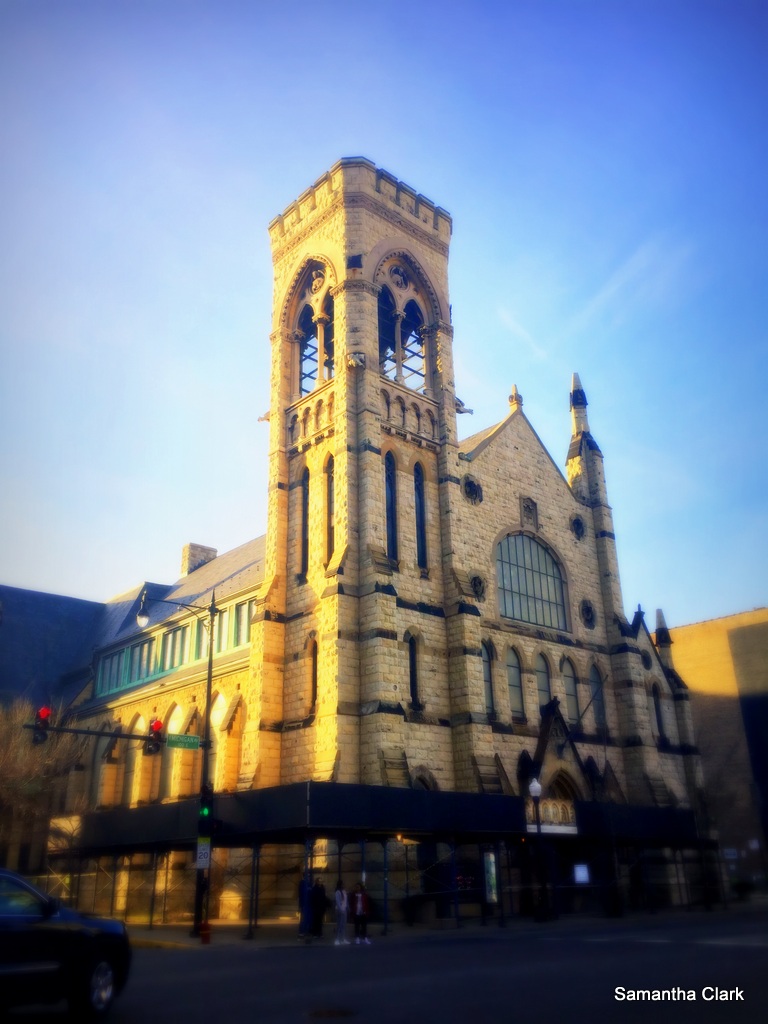
In Woodlawn people are trying to save Shrine of Christ the King Sovereign Priest Catholic church gutted twice by fire. Yesterday it was announced St. Adalbert's in Pilsen (pictured here) didn't raise enough funds for restoration and will be closed.

The skylines of many neighborhoods are about to dramatically change. Seems a shame to lose so many beautiful buildings. I feel like I'm documenting the end of an era.


Friday, February 12, 2016

West Loop, Near West Side


Deciding which neighborhood to visit on the Near West Side was difficult. The area includes unique places, such as Greektown, Fulton Market, and the quiet residential Tri-Taylor. Before moving to Chicago I had read quite a bit about Little Italy, and considered locating my family there. Using Google street views I liked the style of the homes and its proximity to a university and downtown. After nine months of living in Chicago I still hadn’t gone to the neighborhood.

My daughter and I do regularly go the Morgan L (elevated train) stop of the Near West Side. I adore the shrimp grits at Wishbone restaurant, Khloe at Solo Salon is a genius at giving me a beautiful shade of “natural” red hair, and Wigglyville is my favorite spot to buy dog treats.

Still, the point of my project was to experience new places. Before locating to Chicago I’d read about the French Market. Unfortunately, it’s closed on Sundays, when my family and I often travel around the city. I talked my daughter into accompanying me during a weekday to West Loop.

We took the L to the Clinton stop. The French Market was only a block away. While I would have liked to have eaten lunch in one of the finer nearby French restaurants, none I found were within our budget.

I’m a big fan of public markets because they are so important to the health of a community. The eastern side of West Loop is adjacent to Chicago’s downtown and lives in the shadow of one of North America’s tallest skyscrapers, the Willis Tower. (Locals still call the building the Sears Tower.) Rents in West Loop are climbing similarly sky high.

The public market provides space to small and local vendors who couldn’t otherwise afford to be the in the area. We were able to experience interesting food without breaking the bank. The market is located in the Ogilvie Transportation Center, combining two of my favorite things—markets and trains. Shopping in the train station allows Metra commuters to grab groceries or a bite to eat as they pass through.

Nearby is Union Station, serving more Metra lines and Amtrak. Chicago is the largest rail hub in the United States, both for freight and passenger travel. West Loop is unique in that many of those tracks run under the neighborhood. While cities like New York have contentious battles over air rights, the problem for West Loop is ground rights. It’s difficult to find empty places to anchor new buildings along the river.

Upon arrival to the French Market we pursued various vendor stalls to choose our lunch. Options included a number of nationalities, including Mexican and Asian. I was tempted by a Croque Madame sandwich or fresh crepes. In the end, my daughter and I both opted for delicious Belgian hamburgers and fries. I’ve never tried mayo on my fries. It was much tastier than I expected.

After lunch we traversed the eastern side of the neighborhood, starting along the river. It was an unseasonably warm early February day in the low forties. Small groups of people walked in the sunshine or took smoke breaks outside office highrises.

It didn’t take long to complete a loop, going as far as the freeway on the western side. We purposely ended up back at the French Market to find mid-afternoon desserts. There were plenty of chocolates, pastries and sweets. Before we finished I bought treats to take home and some wonderful fresh tortellini to add to our salads for dinner. I plan to keep the market in mind for cold winter days ahead.


Wednesday, September 30, 2015

Lakeshore East in New East Side, Loop

I took the Chicago Architectural Foundation's tour of Aqua and Lakeshore East. The Aqua building is  the most fascinating. It looks different in every photo I see.

The oldest buildings in Lakeshore East date back to mid-century. All of them revolve around nautical themes, although Aqua captures the spirit of water the best.

New East Side. View from Millennium Park.

Lakeshore East is a neighborhood of the New East Side, in The Loop.
The Loop is one of the 77 Community Areas of Chicago.

This building echoes an earlier style of Art Deco.

The New East Side has a concentration of highrises.

Originally Lakeshore East didn't have green spaces beyond container plantings like this.

The most interesting building in the neighborhood is Aqua. I like how it becomes a sculpture.

Aqua on the right.
The neighborhood is built on multiple levels. Staircase down to a surprise.

Staircase.

Surprise! A public park sits in the center of the neighborhood.

The park is framed on all sides by buildings. Until the tour I didn't know the park was there. The development also features a large grocery store I didn't know is three or four blocks from my train stop to go home to the South Side.

LAST LOOK. Aqua among the buildings.