Showing posts with label urban planning. Show all posts

Wednesday, September 25, 2019

Silvertone Chicago Vol.1


The corn cob towers.

This is the first time I've posted to the Chicago Neighborhoods Project in years. I stopped because I found trying to keep up with several types of social media was too time consuming. I am most active on Twitter at @ChiNeighbor. I have been tweeting videos of the city. I also feature snippets of Chicago Tribune newspaper articles from 1893 about the city and the World's Fair.

My longer term project is tentatively called "Tarot in the White City: Instructions, History and Advice from Chicago." I envision this as a book as centered around the amazing research about tarot that emerged in the early 1890s. Part of this knowledge has gone back into obscurity. For fun, I've designed a way to read tarot with a set of dominoes, a partial deck of playing cards, and a partial deck of modern tarot cards.

Visual Journal of the Fantastical City

As for photography, I've taken a new interest in shooting black and white (actually, silvertone) photos. I am exploring what is real and what is not. How the image of the city is constructed through our thoughts. Always there is an element of dreams to what we see.

The beer garden along the Riverwalk.
The autumn season. Shadowy figures crossing Wabash.
Corner clock on the Palmer House Hotel.

The Vietnam Veterans Memorial along the Riverwalk. Wedding couple on far left stairs.
The canopy of lights at the Palmer House Hotel.
Doorways of the Chicago City Hall/Cook County building.

The Riverwalk.

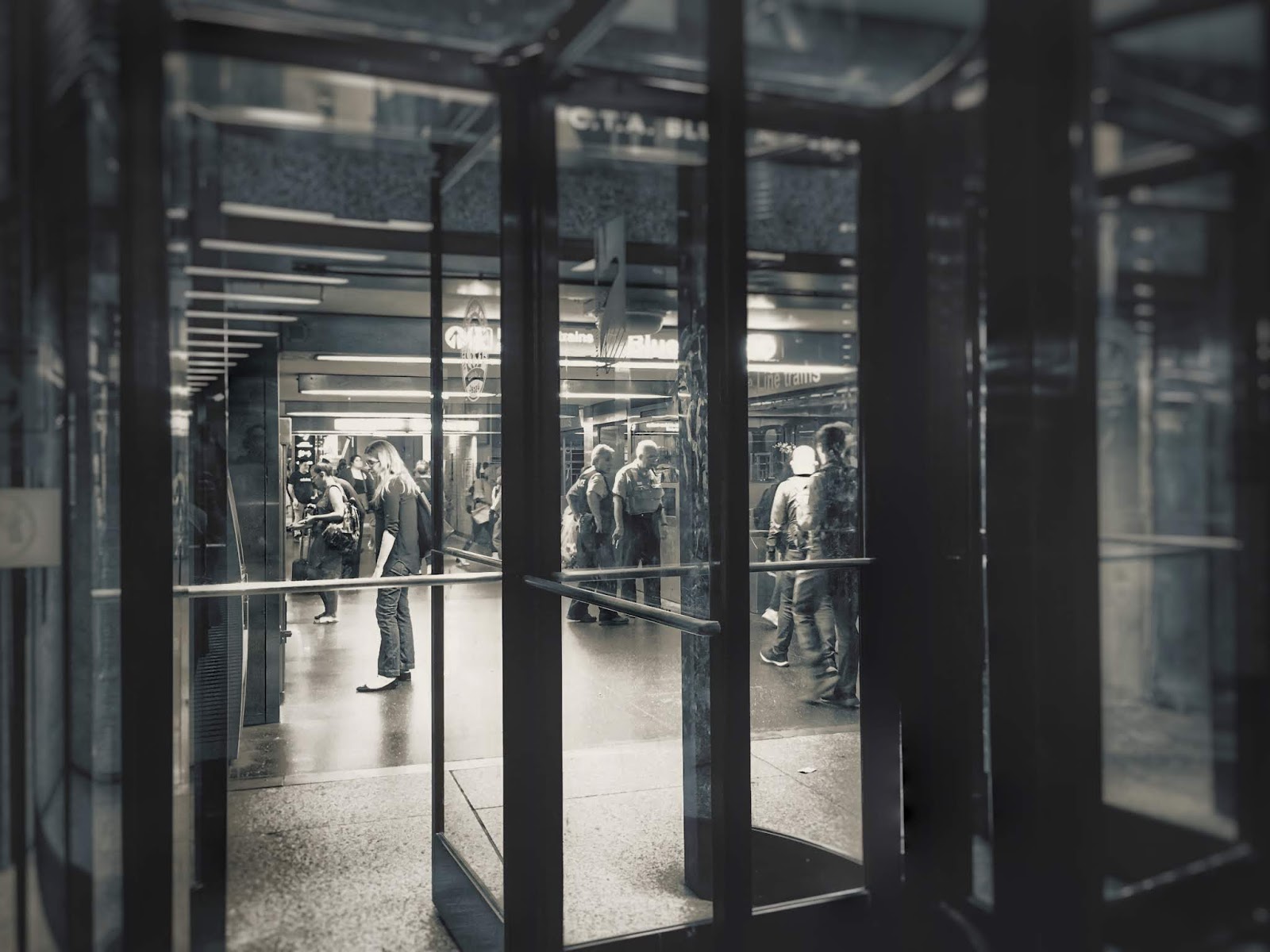
The entrance to the Blue Line along the underground tunnels of the Pedway.

Vending machines and snacks in the Pedway.


Tuesday, May 17, 2016

Englewood


Jahmal Cole runs the group My Block, My Hood, My City (MBMHMC) to encourage Chicagoans to explore the different neighborhoods of the city. MBMHMC takes young people monthly to visit new areas. In April 2016 he started a series of walks to encourage the public to see places they might not otherwise visit. My husband and I joined “Explore Englewood”.

We boarded a southbound bus in our neighborhood of Hyde Park. In Woodlawn we transferred to the 63rd Street bus going west to Englewood. The area wasn’t far from our home, but I’ve never been there. It’s somewhere I don’t generally feel comfortable walking on my own. Meeting a group did encourage us to make the trip.

Everyone gathered at St. Benedict the African-East Church. Tables were set up with information from neighborhood groups and maps with points of interest. Then everyone left on their own to explore and meet together later at a café for lunch. My husband and I began to wander the area.

As we walked Englewood I noticed all of the lots and lawns had been neatly mowed. In its glory days Englewood was a grand neighborhood filled with expensive mansions. In recent times, it has fallen on hard times. However, there are still people who obviously take pride and care for the area.

Upon closer inspection I began to notice that, unlike the North Side, few of the old homes were completely restored. Pieces of the houses were sometimes gone, such a missing spire from a turret, or more perplexing, a spire with a gap where the turret should be. We often saw deferred maintenance, missing or boarded architectural elements, and lots of siding.

I’d read an article in the South Side Weekly about how the housing market crash and subsequent foreclosures continues to devastate certain areas of the city. After Riverdale, the next highest vacancy rates are a cluster in Woodlawn, Englewood, and West Englewood. Even so, I wasn’t prepared for the overwhelming number of boarded homes and vacant lots.

I’d been to East Garfield Park, which experienced high rates of fires and looting during the April 1968 riots. Many buildings in that area of the West Side were burned and later removed, leaving numerous vacant lots.  Almost every business and factory left. Still, East Garfield Park seems more stable now than some areas of the South Side.

According to what little is remembered about the South Side, rioters in April 1968 marched along 63rd Street from Woodlawn to Halsted in Englewood, once the second busiest shopping district in Chicago. It was the same route we’d followed on the bus. Later accounts claimed, because of stronger community leadership, the South Side April 1968 riots were quickly quelled and the communities didn’t suffer the same fate as the West Side.

Regardless, the resulting long term damage from the 1968 riots seems to be similar for both neighborhoods. There was a mass exodus of businesses and many buildings have been reduced to vacant lots in Englewood, just like East Garfield Park. Except the foreclosure crisis hasn’t deeply impacted many places as badly as here. Englewood continues to erode from both historical and recent crises.

The only complete blocks of well-maintained homes, without empty units, appeared to be the newer charity or public housing projects, at least where I walked. Otherwise, nearly everywhere was distressed. It was common to see people living in between boarded and vacant units. I would also see second stories occupied while the first floors were closed off. While sealing the lower levels of abandoned buildings was common, only some had the upper windows boarded.

Homes with people living in them had their curtains drawn and windows closed, despite the beautiful Saturday afternoon. No one seemed to feel it was safe to leave them open. Some of the boarded buildings had a window or two exposed, where the boards were removed. Reportedly they are used for illicit activities, like gangs, drugs or prostitution.

Most of the areas we walked were eerily quiet. With all of the green vacant lots it reminded me of being in the country. We heard lots of crickets. Despite the warmer weather kids weren’t playing out in the fields or parks. Almost no one was walking around. Residents stayed on their porches and kids were only allowed a few feet from their front doors. The playgrounds we passed were completely empty.

Later I was told a railroad company was buying a section of Englewood, tearing the buildings, to expand their railyards into the neighborhood. I suddenly wondered if that was the section we’d traveled? It would have explained a lot. After researching I found out we never saw the railroad expansion area.

We met back with MBMHMC at the Dream Café. Despite the continued distress in Englewood, there are people working to make improvements. New investments are happening, like the building of a Whole Foods grocery store. Local entrepreneurs have met with the store about marketing their products.

There are people who clean trash in front of vacant buildings and plant spring bulbs. I saw an active Little Free Library; which volunteers were keeping stocked with giveaway books. I saw a planter of flowers placed out by the road to enliven the entire street. Residents are fighting to restore their neighborhood.

We enjoyed lunch. My husband tried the jerk chicken and rice, while I couldn’t resist sampling chicken and macaroni and cheese. The pasta had some extra peppers and spices. Afterwards, we walked over to the Aldi grocery store. My husband wanted to see it, as he’s read a lot about how the store significantly undersells Wal-Mart. They’ve brought affordable groceries to food deserts, particularly on the South Side.

I didn’t have a quarter with me to unlock the grocery cart. Aldi gets customers to return carts by charging a deposit. They operate on almost no staff and limited selections of only a brand or two for each item, which lowers their costs. Inside we found the store clean and well lit. Cashiers were extremely fast. We managed to grab a couple bags worth of food and the cashier graciously lent us a cart to bag them.

I’ve seen the location of the H. H. Holmes “Murder Castle” (of Devil in the White City fame) listed as the Aldi store in Englewood. Others cite it being across the street, where the post office is now located. Not surprisingly, the post office is rumored to be haunted. That’s where we caught the bus home.


Friday, April 15, 2016

Albany Park


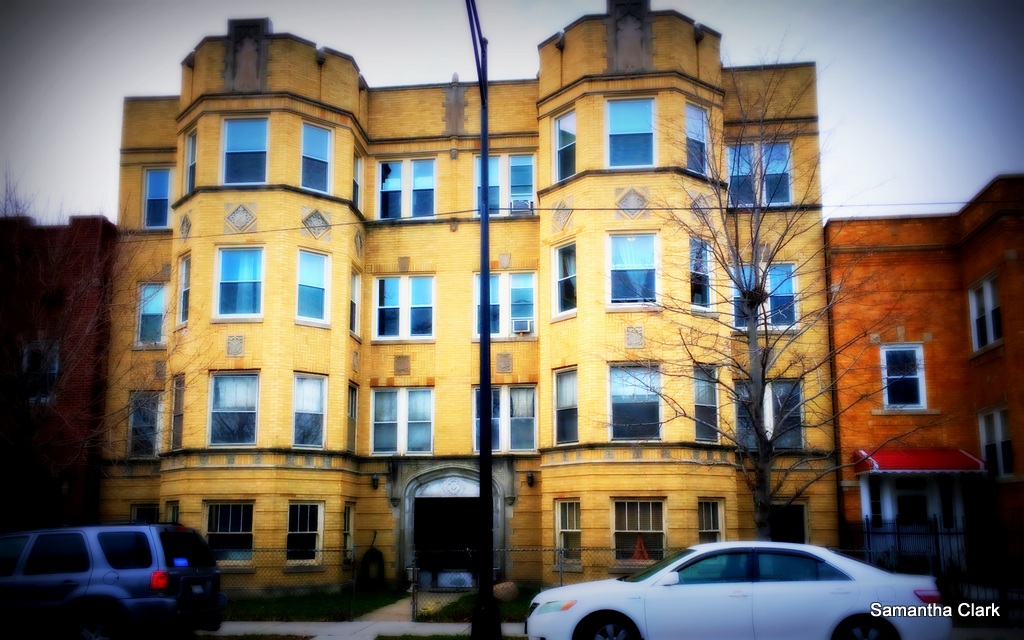
There is something satisfying about riding a train to the end of the line. During the first weekend of April my husband and I took the Kimball brown line L train to the last stop, Kimball, in Albany Park. It was a Saturday with mild weather.

I purposely didn’t research much about the area before we left. Ever since my visit to East Garfield Park I’ve been wary about reading potentially biased information online, which might change how I experience the neighborhood.

When we exited the train station we walked into the middle of chanting protesters holding signs. I figured we must have arrived at the hub of activity for the neighborhood. Protesters tend to congregate where the most people will see them. We glanced up and down Lawrence Ave., the main business street. We saw a bunch of stores off to the left, so we decided to walk west from the train station.

I’d just read about the recently defeated Alderman complaining the area was being overrun by hipsters and yuppies. Looking around my husband commented that the hipsters must not have gotten the memo. If anything, the street looked like the Land That Time Forgot, circa 1980. It was a preserved street of pre-gentrification gritty inner city.

I was reminded of New York City, when Times Square was still full of peep shows and questionable electronics stores. It made me strangely nostalgic for the NYC I remembered as an art student at Pratt in the late 1980s.

West of the train station Lawrence was lined with an abundance of quaint businesses, like lots of travel agencies, shoddy imported foreign goods, and even a photo store. I haven’t seen a business specifically for processing photographs in years. I was also reminded of why modern efficient corporations, such as Walmart, are popular instead of some of the seedier retailers. It’s easy to be too nostalgic for the old days.

As we walked farther we noticed a restored theater. Across the façade was a quotation about freedom. As we got closer we could read the attribution… Larry Flynt, the famous pornographer. Later we would find out that the Admiral, and surrounding businesses, were a magnate for travelers going through O’Hare airport. However, the adult theater had recently won a good neighbor award for its exemplary civic participation.

If we had wanted to find the changing parts of the neighborhood, with the hipsters and yuppies, we should have gone east and south from the train station. That area was filling with trendy ethnic restaurants and coffee shops.

At one time Albany Park was Chicago’s Koreatown. There were still a number of signs lettered in Korean, although I saw a lot of vacant store fronts. The area is one of the most ethnically diverse in the country. I sensed an uneasy truce among the different nationalities. I was amazed at how many “we call police” and home security signs we saw in front of residences.

Along Lawrence were a wide range of hole-in-the-wall restaurants. I’m not picky, but none tempted us. Finally, we decided to seek out a well rated spot for thin crust pizza. To reach the dining room we first walked through the take out package liquor store, past the length of the bar, to the dimly lit back.

Like most of the other businesses, it was a throwback to an earlier time. The décor was red vinyl booths, floor length mirrors on wood paneling, with accent rock walls. The menu boasted the last time it was remodeled was the late 1970s. The only recent update I could find was an electronic jukebox, which could be accessed through a mobile app and took credit cards. The thin crust pizza was good, although we prefer options in the South Loop.
So far the restaurant is the only place in the north where I’ve seen White Sox games broadcast instead of the Cubs. We had the dining room to ourselves. Only bar flies sat in front along the stools. The waitress said their regular diners were out with their families for Easter weekend. Our own daughter was away on a trip to Germany, so I was fine with skipping the family-oriented celebrations.

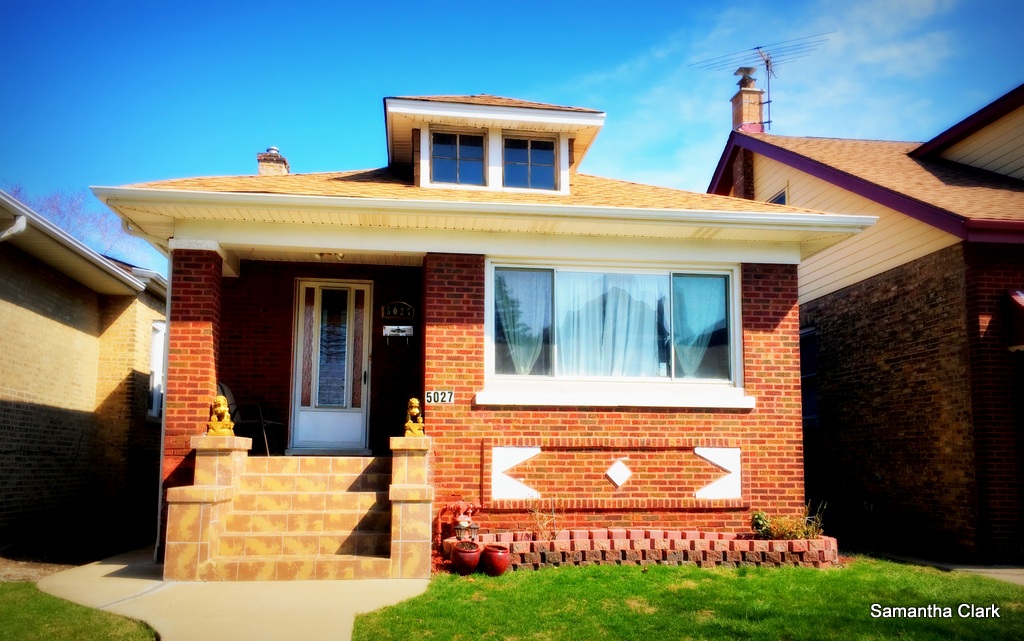
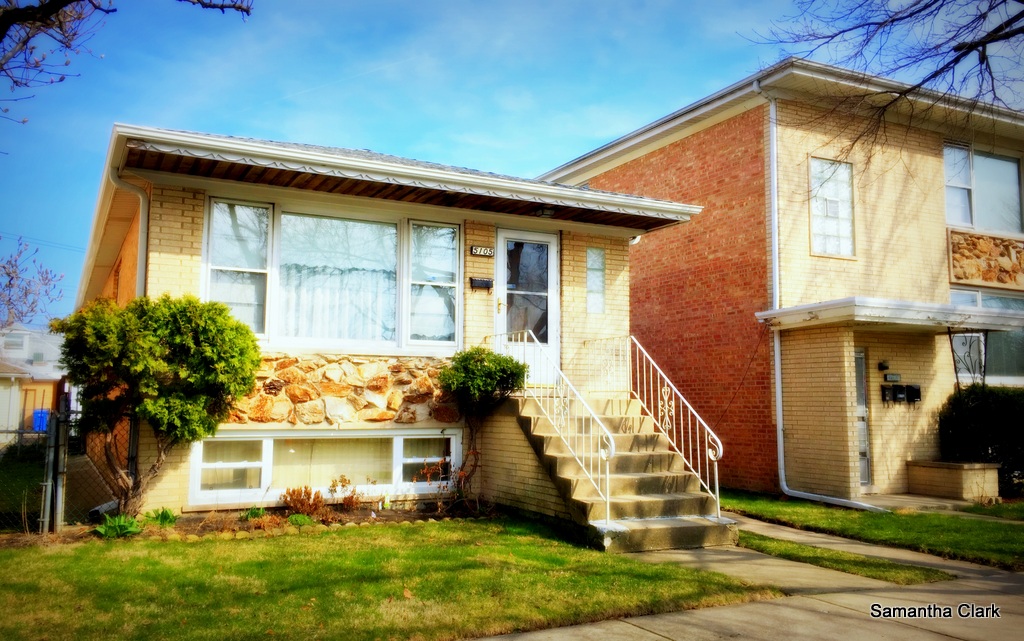
After lunch we walked mostly in the North Mayfair district of historic brick bungalows. We were surprised to find ourselves at the southern edge of a large forest preserve, which continues north and into the suburbs. As we strolled I noticed a section of the bungalows had unique stain glass windows. None appeared to be standard. They changed from house to house.

When we started getting tired of walking I thought I’d found a trail back to the edge of the forest preserve, where we could catch a bus to the train station. When we arrived it turned out to be a section of abandoned elevated train tracks instead. I wondered if it would be turned into a multi-use trail in the future, like the 606. Seems like Albany Park is one more area of the city headed for changes.


Tuesday, March 22, 2016

East Garfield Park


There are neighborhoods in Chicago I don’t feel comfortable walking without guidance. The biggest issue is crime. Will I be safe? The answers are difficult to find, despite diligent online research.

Googling “Chicago’s worst neighborhoods” yields interesting results. A lot of the answers, particularly in forums, tends to reflect perceptions rather than actual statistics. Tourists worry more about being mugged in a very poor neighborhood, when they should be aware that garden variety pick pockets tend to congregate where the action is—tourist hot spots, particularly when late night bar hopping is added to the mix.

Searching online some neighborhoods, like Auburn Gresham, North Lawndale, and Washington Park, tend to show up consistently on “bottom” lists. East Garfield Park, while suffering from higher than average city crime rates, isn’t a shoo in for a “worst 10” neighborhood. The numbers vary. The discussion forums are a different matter. The comments constantly warn against visiting.

While I wouldn’t advise walking unfamiliar neighborhoods alone at night anywhere, tourists and many Chicagoans seem unfairly prejudiced against East Garfield Park even during the day. Getting off the green line at the Conservatory L train stop leads directly to one of the most impressive conservatories in the country. I like it better than Lincoln Park and it has more family-friendly areas. There just isn’t much to do beyond the park.

I crossed paths on social media with Dr. Peter T. Alter, Historian and Director of the Studs Terkel Center of Oral History at the Chicago History Museum. He was in the process of helping raise money for "Forty Blocks:The East Garfield Park Oral History Project.” It would train students from Breakthrough Ministries' Art and Science Academy to interview local residents about the neighborhood.

I have been asked why I don’t document neighborhoods more thoroughly when I visit, particularly the people. The answer is it would require resources like the Forty Blocks project—dozens of committed people, funding, and many hours of work per neighborhood. It takes an entire team.

What Chicago really needs is a Forty Blocks type project in every neighborhood of the city, hopefully produced by the people who live there. I am a tourist of the city taking snap shots of the architecture, capturing a particular place and time.

Alter suggested lunch at the Inspiration Kitchen, located near the conservatory. I had chicken and waffles with an egg, creole mustard, and cayenne syrup. Coming from the spicy Southwest I found the sauces mild but good. Alter had a catfish PoBoy.

I’m always hesitant to walk through a new neighborhood with someone I don’t know. Luckily, Alter has experience working with media and film crews. He was already trained to stay out of the way of my camera view. Beforehand, I realized it was kind of rude of me to suggest he show me around, then only pay half attention to what he was saying as I became engrossed in photography. I was able to solve the issue by getting some video clips of his tour.

In hindsight, I was glad he was there. I didn’t always understand what I was seeing. East Garfield Park is a once prosperous area that has declined dramatically from the 1950s. More than two-thirds of the residents have left. The area is Chicago’s own piece of the Midwestern rust belt. I felt like I was looking at Detroit.

Alter explained Chicago had two major periods of riots in 1968. The summer riots of the Democratic convention are well known. But earlier that year, in April, riots broke out across the city after the assignation of Dr. Martin Luther King, Jr. While King lived in Chicago he was based in the neighborhood just south of the train tracks, in Lawndale. Historically, the area was one of the first places in the western part of the city to be settled by blacks leaving the South Side after World War II.

During the April riots a significant number of homes and businesses burned in Lawndale and some surrounding areas. They were never rebuilt. The empty lots we were seeing in East Garfield Park weren’t just due to the recent housing crisis. There had been a mass exodus of factories, businesses and jobs since mid century.

During the last housing boom there was a lot of speculation about East Garfield Park gentrifying. It’s close to downtown and has good public transportation. Looking around I had to wonder—gentrify what? So much of the neighborhood is simply gone. It’s not going to be the work of fix-and-flippers or hipsters.

If the neighborhood is going to change it would take an effort like the Chicago Housing Authority in Bronzeville, transforming large blocks at a time with mixed income housing, or the South Loop, where developers are inserting large luxury projects. Even then, both of the aforementioned communities lack significant business development.

Walking around I thought I saw signs of new commercial investment in the neighborhood. I pointed out a great little grocery store. Alter explained no, it was actually a food pantry run by Breakthrough urban ministries. Ditto for the gym, child care and health center. Our lunch restaurant was likewise a social service. Almost no commercial businesses exist in the area. We did pass an urban farm with a B & B nearby.

Residents have few services. Our tour was in early March. Several times we resorted to walking in the street because sidewalks were coated in sheets of ice. They wouldn’t be cleared until they melted. The situation is particularly difficult for the elderly. When I later looked online I was surprised at how high the neighborhood rents are given the condition of the area.


We ended the tour by walking down the once grand West Washington Boulevard. Some of the old mansions remain. To the west it terminates at the extraordinary Garfield Park field house owned by the city park district. Parting ways with Alter I explored the incredible marble and metal work inside. It’s one of Chicago’s relatively unknown architectural treasures, at what was once one of the country’s grandest parks, in what was one of the finer neighborhoods.