Showing posts with label nordamerika. Show all posts

Sunday, May 22, 2016

Budget Guide to Chicago

Summer 2016


When the weather warms tourists flock to Chicago. Since I get requests for advice about what to see and do in the city, I’ve compiled a budget guide for visiting. Please feel free to leave your own tips.


Choosing What to Visit


Finding the expensive attractions is easy. They are well known. They appear on every website and guide book. Whenever I travel I’m on a limited budget and appreciate finding the cheap stuff. I prefer to blow my money on one big great thing, then supplement the rest of the trip with low cost or free activities.

The first time I go to a new city I spend most of the time simply walking around. If I’ve already been somewhere I prefer a return visit to explore a theme. In a metropolitan area as large as Chicago there is no way to cover all the museums from Millennium Park north to Lincoln Park, let alone the rest of the city. The sheer number of choices is overwhelming.

When friends come to visit I’m left trying to find out clues about what might interest them. If they like architecture, do they want to explore a larger area by walking on our own, or do they want a shorter, but much more informative, professionally guided tour? Do they prefer trolley, subway, bike or walking? (I draw the line at Segways.)

What aspect of architecture is compelling? Do they want skylines and a history if how Chicago developed? Or do they have a specific interest in churches, gothic architecture, hotel lobbies, Frank Lloyd Wright, park district field houses and conservatories, high end retail buildings, famous restaurants, train depots, public markets, or something else?

 Pick a Theme


I like to explore a city around a theme. Right now I’m interested in the Edwardian Era of history. In Chicago I would take some architectural tours of buildings and foods (Chicagoans often combine architecture and eating or drinking), check for museum exhibits, and visit some house museums like Glessner.

If you’re looking for something educational you might explore birds, Civil War history, cooking and foods, bridges, or whatever floats your boat. Chicago has a number of museums and cultural centers devoted to specific ethnic heritages, including Swedish, German, Lithuanian, African-American, Ukrainian, Mexican and Puerto Rico.

Chicago has an endless number of tours, concerts and lectures. The universities often have free or low cost theater, music and lectures. Likewise, neighborhoods sponsor inexpensive events.

In my own neighborhood of Hyde Park this summer we’ll have a series of free weekly evening concerts on our main street (53rd), free park concerts and movies, a free 3-day Jazz Festival, gallery openings, inexpensive museums on the University of Chicago campus, 4th of July parade and picnics with fireworks all night, fire pits for cookouts at Promontory Point, lectures, author readings, a new comedy club, and stuff I’m probably forgetting.


I haven’t listed the neighborhood restaurants, architecture, main business district, book stores, public sculptures, the cluster of seminaries, the lakefront, beaches, or the parks. We’re just one small area of the city, yet we have more cultural institutions than some entire small cities.

 
Pick an Area of Town


I recommend sticking to a particular area of the city rather than trying to cover a large territory. Why waste vacation time stuck sitting in traffic or waiting for the subway? Some of the neighborhoods have easy access on public transit to The Loop, Navy Pier, or the Magnificent Mile, but plenty of neighborhoods don’t. If everything you want to do is near the Navy Pier, paying higher hotel costs is worth the easy access.


Leave the Car at Home


I don’t recommend driving around Chicago. It may seem cheaper, until you have to pay parking. Some hotels offer lower room rates with expensive parking garages. Be sure to find out both. Driving to places like downtown is a nightmare and you’ll have to pay for parking. Other neighborhoods require a long search for a free spot.

You may find an inexpensive AirBnB rental with free parking. Fine, but how are you going to get to tourist attractions? Will you have an hour bus ride each way, including having to transfer? Are you going to drive and pay high parking fees when you arrive at your destination?

 
You Don’t Have to Visit the Art Museum


I hereby give you permission to skip anything which doesn’t interest you. You might be happier spending $300 on one of the best dinners of your life rather than slogging through days of boring museums.


Budget Ideas


Since money doesn’t grow on trees, here are some ways to see and do popular attractions without breaking the bank.

·         Discount Tickets: There are passes, Groupon, and last minute discounts.
·         Skyline: Instead of the Willis or Hancock towers, grab a drink at a rooftop bar.
·         River: Take the water taxi from Michigan Ave to Chinatown.
·         Meet Up: Check for free public tours.
·         Museums: Visit less well known museums.
·         Discount Shopping: Chinatown, Clark St in Andersonville, 26th St in Little Village


Links to Low Cost/Free Stuff


Chicago on the Cheap http://chicagoonthecheap.com/


Tuesday, May 17, 2016

Englewood


Jahmal Cole runs the group My Block, My Hood, My City (MBMHMC) to encourage Chicagoans to explore the different neighborhoods of the city. MBMHMC takes young people monthly to visit new areas. In April 2016 he started a series of walks to encourage the public to see places they might not otherwise visit. My husband and I joined “Explore Englewood”.

We boarded a southbound bus in our neighborhood of Hyde Park. In Woodlawn we transferred to the 63rd Street bus going west to Englewood. The area wasn’t far from our home, but I’ve never been there. It’s somewhere I don’t generally feel comfortable walking on my own. Meeting a group did encourage us to make the trip.

Everyone gathered at St. Benedict the African-East Church. Tables were set up with information from neighborhood groups and maps with points of interest. Then everyone left on their own to explore and meet together later at a café for lunch. My husband and I began to wander the area.

As we walked Englewood I noticed all of the lots and lawns had been neatly mowed. In its glory days Englewood was a grand neighborhood filled with expensive mansions. In recent times, it has fallen on hard times. However, there are still people who obviously take pride and care for the area.

Upon closer inspection I began to notice that, unlike the North Side, few of the old homes were completely restored. Pieces of the houses were sometimes gone, such a missing spire from a turret, or more perplexing, a spire with a gap where the turret should be. We often saw deferred maintenance, missing or boarded architectural elements, and lots of siding.

I’d read an article in the South Side Weekly about how the housing market crash and subsequent foreclosures continues to devastate certain areas of the city. After Riverdale, the next highest vacancy rates are a cluster in Woodlawn, Englewood, and West Englewood. Even so, I wasn’t prepared for the overwhelming number of boarded homes and vacant lots.

I’d been to East Garfield Park, which experienced high rates of fires and looting during the April 1968 riots. Many buildings in that area of the West Side were burned and later removed, leaving numerous vacant lots.  Almost every business and factory left. Still, East Garfield Park seems more stable now than some areas of the South Side.

According to what little is remembered about the South Side, rioters in April 1968 marched along 63rd Street from Woodlawn to Halsted in Englewood, once the second busiest shopping district in Chicago. It was the same route we’d followed on the bus. Later accounts claimed, because of stronger community leadership, the South Side April 1968 riots were quickly quelled and the communities didn’t suffer the same fate as the West Side.

Regardless, the resulting long term damage from the 1968 riots seems to be similar for both neighborhoods. There was a mass exodus of businesses and many buildings have been reduced to vacant lots in Englewood, just like East Garfield Park. Except the foreclosure crisis hasn’t deeply impacted many places as badly as here. Englewood continues to erode from both historical and recent crises.

The only complete blocks of well-maintained homes, without empty units, appeared to be the newer charity or public housing projects, at least where I walked. Otherwise, nearly everywhere was distressed. It was common to see people living in between boarded and vacant units. I would also see second stories occupied while the first floors were closed off. While sealing the lower levels of abandoned buildings was common, only some had the upper windows boarded.

Homes with people living in them had their curtains drawn and windows closed, despite the beautiful Saturday afternoon. No one seemed to feel it was safe to leave them open. Some of the boarded buildings had a window or two exposed, where the boards were removed. Reportedly they are used for illicit activities, like gangs, drugs or prostitution.

Most of the areas we walked were eerily quiet. With all of the green vacant lots it reminded me of being in the country. We heard lots of crickets. Despite the warmer weather kids weren’t playing out in the fields or parks. Almost no one was walking around. Residents stayed on their porches and kids were only allowed a few feet from their front doors. The playgrounds we passed were completely empty.

Later I was told a railroad company was buying a section of Englewood, tearing the buildings, to expand their railyards into the neighborhood. I suddenly wondered if that was the section we’d traveled? It would have explained a lot. After researching I found out we never saw the railroad expansion area.

We met back with MBMHMC at the Dream Café. Despite the continued distress in Englewood, there are people working to make improvements. New investments are happening, like the building of a Whole Foods grocery store. Local entrepreneurs have met with the store about marketing their products.

There are people who clean trash in front of vacant buildings and plant spring bulbs. I saw an active Little Free Library; which volunteers were keeping stocked with giveaway books. I saw a planter of flowers placed out by the road to enliven the entire street. Residents are fighting to restore their neighborhood.

We enjoyed lunch. My husband tried the jerk chicken and rice, while I couldn’t resist sampling chicken and macaroni and cheese. The pasta had some extra peppers and spices. Afterwards, we walked over to the Aldi grocery store. My husband wanted to see it, as he’s read a lot about how the store significantly undersells Wal-Mart. They’ve brought affordable groceries to food deserts, particularly on the South Side.

I didn’t have a quarter with me to unlock the grocery cart. Aldi gets customers to return carts by charging a deposit. They operate on almost no staff and limited selections of only a brand or two for each item, which lowers their costs. Inside we found the store clean and well lit. Cashiers were extremely fast. We managed to grab a couple bags worth of food and the cashier graciously lent us a cart to bag them.

I’ve seen the location of the H. H. Holmes “Murder Castle” (of Devil in the White City fame) listed as the Aldi store in Englewood. Others cite it being across the street, where the post office is now located. Not surprisingly, the post office is rumored to be haunted. That’s where we caught the bus home.


Thursday, April 21, 2016

West Ridge


In early April my husband, daughter and I decided to try a new food. My husband had been suggesting Middle Eastern for a while, although we never seemed to get around to eating it, despite a couple of decent restaurants near our home. After an online search we agreed to try something foreign to us—Shawarma cooking. We found some good restaurant reviews in West Ridge.

From downtown we took the brown line L train to the Western stop, then hopped a bus north. We arrived at an Assyrian Shawarma hole-in-the-wall restaurant, not quite in the neighborhood. We agreed to check it out, and if it didn’t appeal, we would find another among several options in West Ridge. The place was modest but the food looked good. The meat was slowly roasted on a spit, similar to Greek gyros. Our meals turned out to be delicious and plentiful.

I wouldn’t travel across town for a Shawarma meal again. However, if it was available in my own neighborhood, I would eat it on a regular basis. The unique foods are what makes so many of the individual neighborhoods of the city special.

After lunch we walked along Highway 41 before turning north into the residential areas. I was surprised to see some old motor court motels, like those typically found along old Route 66 across the country. In Chicago there’s not much left of the Mother Road. I was happy to find “Route 66” style architecture elsewhere in the city.

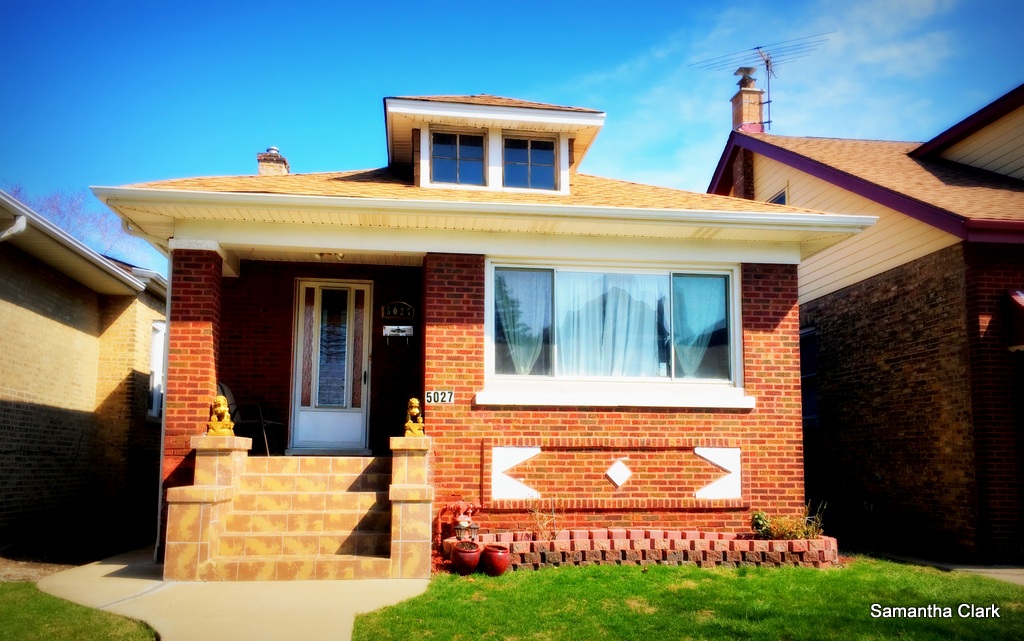
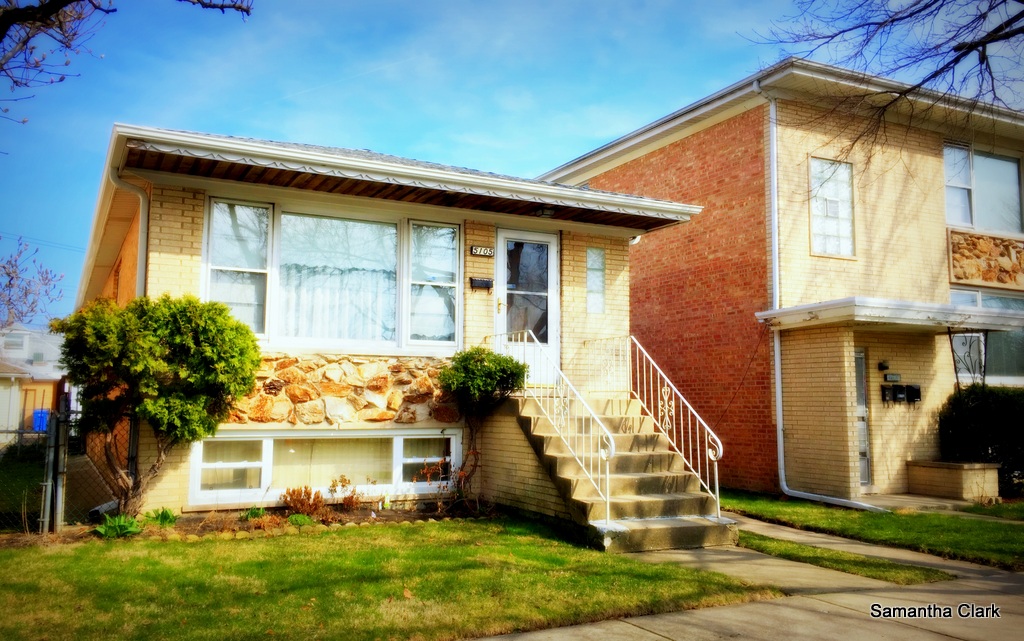
The Encyclopedia of Chicago notes West Ridge experienced a building boom from World War I through the 1960s. We found a diversity of architectural styles, from typical Chicago brick bungalows, a few with whimsical details, to unusual mid-century modern two-flats.

We walked until we reached Devon, the main business district street. The stores were quite diverse. Area residents included Indians, Pakistanis, Koreans, Middle Easterners, Bangladeshi, Russians, Assyrians, decedents of Germans and Irish, and the Midwest’s largest community of Hasidic Jews.
Unlike Albany Park, the different ethnic groups seemed comfortable comingling with each other. It was common to see bakeries with a mix of offerings or store signs in a variety of languages. My only complaint were the bagels we bought, which turned out to be more like bread rolls with a hole in the center, rather than the boiled dough goodness I’ve come to expect. We used them as sandwich buns.

The commercial district was thriving with a wide range of restaurants and types of local businesses. I got the sense the area is stable and not experiencing the pressures of either displacement, or abandonment, so common in the rest of the city.

We bought bakery breads, then explored a Middle Eastern market. I always like to look through the grocery shelves, trying to guess the items labeled in other languages. Like so many small ethnic markets around the city we found plenty of inexpensive items. We loaded up on boxes of tea and dry lentils.

In addition, I treated myself to a set of double metal tea kettles. I’d noticed them in some other Middle Eastern stores around town. Water is boiled in the larger bottom kettle, while the smaller top kettle heats. Then the smaller kettle is used as a pre-heated tea pot. They had several models, so I asked which they would recommend. The proprietor explained she preferred the set where the two kettles, large and small, could be used separately, and the top one included a fitted tea strainer. So far, I’ve used them daily with great results.


Friday, April 15, 2016

Albany Park


There is something satisfying about riding a train to the end of the line. During the first weekend of April my husband and I took the Kimball brown line L train to the last stop, Kimball, in Albany Park. It was a Saturday with mild weather.

I purposely didn’t research much about the area before we left. Ever since my visit to East Garfield Park I’ve been wary about reading potentially biased information online, which might change how I experience the neighborhood.

When we exited the train station we walked into the middle of chanting protesters holding signs. I figured we must have arrived at the hub of activity for the neighborhood. Protesters tend to congregate where the most people will see them. We glanced up and down Lawrence Ave., the main business street. We saw a bunch of stores off to the left, so we decided to walk west from the train station.

I’d just read about the recently defeated Alderman complaining the area was being overrun by hipsters and yuppies. Looking around my husband commented that the hipsters must not have gotten the memo. If anything, the street looked like the Land That Time Forgot, circa 1980. It was a preserved street of pre-gentrification gritty inner city.

I was reminded of New York City, when Times Square was still full of peep shows and questionable electronics stores. It made me strangely nostalgic for the NYC I remembered as an art student at Pratt in the late 1980s.

West of the train station Lawrence was lined with an abundance of quaint businesses, like lots of travel agencies, shoddy imported foreign goods, and even a photo store. I haven’t seen a business specifically for processing photographs in years. I was also reminded of why modern efficient corporations, such as Walmart, are popular instead of some of the seedier retailers. It’s easy to be too nostalgic for the old days.

As we walked farther we noticed a restored theater. Across the façade was a quotation about freedom. As we got closer we could read the attribution… Larry Flynt, the famous pornographer. Later we would find out that the Admiral, and surrounding businesses, were a magnate for travelers going through O’Hare airport. However, the adult theater had recently won a good neighbor award for its exemplary civic participation.

If we had wanted to find the changing parts of the neighborhood, with the hipsters and yuppies, we should have gone east and south from the train station. That area was filling with trendy ethnic restaurants and coffee shops.

At one time Albany Park was Chicago’s Koreatown. There were still a number of signs lettered in Korean, although I saw a lot of vacant store fronts. The area is one of the most ethnically diverse in the country. I sensed an uneasy truce among the different nationalities. I was amazed at how many “we call police” and home security signs we saw in front of residences.

Along Lawrence were a wide range of hole-in-the-wall restaurants. I’m not picky, but none tempted us. Finally, we decided to seek out a well rated spot for thin crust pizza. To reach the dining room we first walked through the take out package liquor store, past the length of the bar, to the dimly lit back.

Like most of the other businesses, it was a throwback to an earlier time. The décor was red vinyl booths, floor length mirrors on wood paneling, with accent rock walls. The menu boasted the last time it was remodeled was the late 1970s. The only recent update I could find was an electronic jukebox, which could be accessed through a mobile app and took credit cards. The thin crust pizza was good, although we prefer options in the South Loop.

So far the restaurant is the only place in the north where I’ve seen White Sox games broadcast instead of the Cubs. We had the dining room to ourselves. Only bar flies sat in front along the stools. The waitress said their regular diners were out with their families for Easter weekend. Our own daughter was away on a trip to Germany, so I was fine with skipping the family-oriented celebrations.

After lunch we walked mostly in the North Mayfair district of historic brick bungalows. We were surprised to find ourselves at the southern edge of a large forest preserve, which continues north and into the suburbs. As we strolled I noticed a section of the bungalows had unique stain glass windows. None appeared to be standard. They changed from house to house.

When we started getting tired of walking I thought I’d found a trail back to the edge of the forest preserve, where we could catch a bus to the train station. When we arrived it turned out to be a section of abandoned elevated train tracks instead. I wondered if it would be turned into a multi-use trail in the future, like the 606. Seems like Albany Park is one more area of the city headed for changes.


Thursday, March 31, 2016

Little Village, South Lawndale


My daughter wanted to find a sovenier from Mexico. She was about to leave on a solo three-week trip to Germany. One of the people she was planning to meet asked if she could bring him a Mexican trinket from Chicago. Back in Albuquerque, where we used to live, the request would have been easy. Now that we lived in Hyde Park we would have to travel to another part of the city to find it.


“Really?” I asked. I was in a grumpy mood. Did we really have to spend an afternoon buying a two-dollar trinket before she left? Finally, she made a peace offering. She volunteered to go tour a new neighborhood with me.

I started looking online at Mexican retail shops. We’d already been to some of the neighborhoods listed, including Bridgeport and Pilsen. Some of the shops on the north side of the city would take a couple hours, each way, to reach on public transportation from our home. We would have to make at least 3 route transfers.

Looking at the distant areas in the north I didn’t know how I was going to get there in the future. At some point I was going to have to make the trip. I decided not to worry about it now. So far, I was managing to find my way around. During my project answers have had a way of appearing when I need them.

The obvious solution to our current dilemma was to shop in the Little Village of Lawndale, a neighborhood of primarily Mexican immigrants. I’d read that their 26th Street has the second highest amount of retail revenue along any street of Chicago. Only the Miracle Mile on North Michigan is higher. Little Village sells more goods than State Street in downtown.

Since we were familiar with the neighboring Pilsen, we took the pink line L one stop further west to the Kedzie stop. Whether the station is located in North Lawndale or Little Village depends on the map consulted. The two block walk south from the L station to the Metra train tracks did seem like a “no man’s land” with trash piled as high as my knees as we crossed under the Metra bridge.

We arrived in the Little Village neighborhood in mid-afternoon as the schools were letting out. Groups of kids and families were everywhere on the streets. I instantly felt safe when surrounded by women and children. I’ve since read that encouraging groups of immigrants to settle in troubled neighborhoods has been shown to reduce crime rates.

The area was a stark contrast to my previous neighborhood visit of East Garfield Park. Whereas Garfield Park’s streets were mostly barren of people or commercial businesses, even in the middle of the day, the Little Village was full. Neighbors seemed to know each other and would stop to chat in small groups. More strikingly, the area was bursting with small, local merchants.

Part of the explanation was culture. There was a spirit of entrepreneurship and commitment to shop the local merchants. But partially it was the architecture. There must have been hundreds of tiny, affordable stores spaces to rent. Shops could flourish because they have the physical space to do so in a concentrated area.

Even beyond the main commercial corridors there were plenty of tiny shops and corner stores among the homes. When buildings are being torn across the city, sadly, tiny storefronts like these are not being replaced. As the weather was mild for March I also saw lots of card tables set up on sidewalks to sell even more goods.

The greatest difficulty we had getting around the neighborhood was trying to cross the busier streets. There were few traffic lights and cars often didn’t stop for pedestrians in the cross walks. I watched other people have the same problem trying to get to the other side.

As we walked my daughter noticed a store full of religious icons. Inside we found ourselves in the Costco of religious supplies. There must have been hundreds of each item, most still in their boxes stacked on shelves. My daughter found a small icon to take on her trip. After hunting through numerous bottles of spiritual oils, and noticing the stack of voodoo dolls, it dawned on me the store catered to more than the local Catholics.

Later, when I checked on Google for voodoo supplies in Chicago, nothing was listed for Little Village. It made me wonder what else I might find tucked away in the stores. I plan to return to treasure hunt through the shops.

Afterwards, we wandered into a cheese shop with a full size statue of a cow in front. We were given samples of their white Mexican cheese to sample in soft, medium and hard varieties. I bought a couple to take home. I would later eat the hard as string cheese snacks. The medium I used to bake a delicious pan of black bean green chile cheese enchiladas.